
We must protect Social Security and Medicare
by A. Altieri D’Angelo
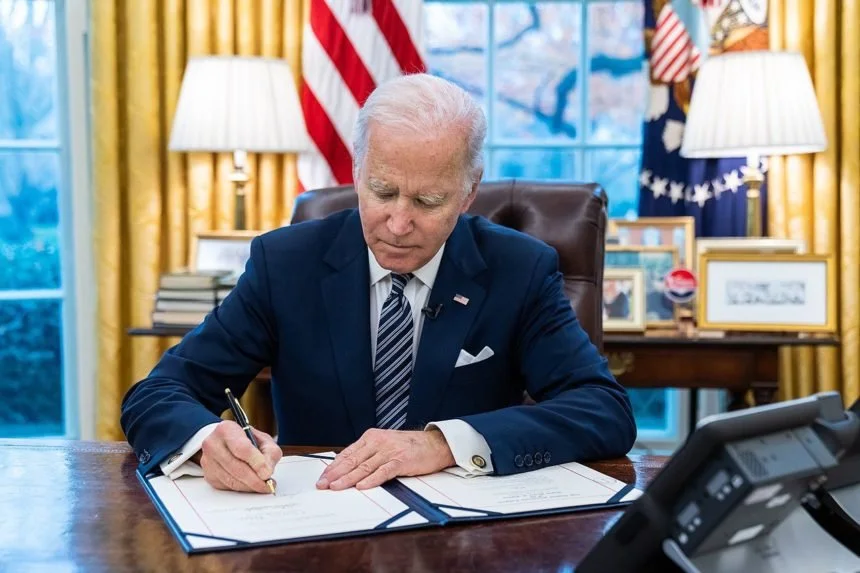
Photo: President Joe Biden signs S. 610, the “Protecting Medicare and American Farmers from Sequester Cuts Act,” Friday, December 10, 2021, in the Oval Office. (Official White House Photo by Adam Schultz)
In his recent State of the Union speech, President Biden managed to shame Republican Party members of both chambers of the U.S. Congress (the Republicans) into proclaiming they would not cut Social Security or Medicare.
In his speech, Biden said, “Some Republicans want Social Security and Medicare to sunset. He said, “Anybody who doubts it, contact my office, I’ll give you a copy of the proposal.” (He was referring to a plan issued by Senator Scott Perry that called for all federal programs to sunset).
At this point, Republicans were booing and shouting "No.” Rep. Marjorie Taylor Greene (R-Ga.) stood up and pointed her finger at Biden, and yelled “liar” after she sat down. The President then took the opportunity provided by the Republicans to say, "Well, I’m glad to see — and now, I tell you, I enjoy conversion,” He did say it was not a majority of Republicans that were pushing for such cuts.
Biden summarized the discussion by stating, “So folks, as we all apparently agree, Social Security and Medicare is off the books now, right?” Biden said. He gave a thumbs up. “Let’s all agree — and we apparently are — let’s stand up for seniors,” Biden said. “We will not cut Social Security. We will not cut Medicare. If anyone tries to cut Social Security — which apparently they're not going to do — and if anyone tries, and Medicare, I'll stop them. I'll veto it".
All the Democrats in the room and many Republicans stood up and applauded. It was a masterful display of political theater. Biden managed to get the Republicans to publicly admit they would not use the threat of cuts to either program as part of the debate on cutting the U.S. budget deficit. Unfortunately, as brilliant as Biden’s handling of the Republicans was, the fact remains that both social programs will run out of money. The U.S. can no longer avoid dealing with this underfunding problem.
Both programs are hugely popular and needed. The benefits, however, are modest; workers have earned them by paying a Social Security tax imposed on wages of not more than $160,200 per annum— protecting themselves and their families if they retire, become disabled, or die. Most current beneficiaries rely on Social Security for much of their income. Social Security is the only income guaranteed to last as long as they live and provide complete inflation protection. Social Security benefits in the United States are lower than in many developed countries. Sadly, future retirees will most likely receive lower benefits (relative to their past earnings) than current retirees because of a rising Social Security retirement age and escalating Medicare premiums.
Social Security trustees project that its trust fund reserves will last until 2035, and after that, tax revenue anticipated under current law would support only three-fourths of scheduled benefits. Social Security’s fundamental challenge is that fewer people are paying into the system, but the increasing number of beneficiaries escalates costs per beneficiary in the mid-2030s.
Medicare is a federal health insurance program funded by a payroll-based tax on total wages. It covers people 65 or older, certain younger people with disabilities, and people with End-Stage Renal; Disease (permanent kidney failure requiring dialysis or a transplant, sometimes called ESRD). As of October 2021, the total Medicare enrollment was @36 million people. The Medicare Hospital Insurance Trust Fund is projected to exhaust its funding by 2028 — at that point, it would have sufficient revenue to meet 90 percent of its obligations.
Keeping Social Security (and Medicare) solvent is not new. In 1983, a blue-ribbon commission was formed to review the program and make recommendations for keeping it solvent. The Report of the National Commission on Social Security made many recommendations. But most proved to be politically unpopular. President George W. Bush (in 2005) made Social Security reform his top domestic priority. Unfortunately, by early summer (2005), the initiative was on life support, with congressional Democrats uniformly opposed and Republicans in disarray. By October, the President abandoned his plan.
Democrats and Republicans offer different solutions for eliminating the solvency issue.
Biden seeks to raise taxes on people earning more than $400,000 (from all income sources). Republicans seek to increase the retirement age from 67 to 79 and change the benefits formula, thereby decreasing monthly payments. The ultimate solution will consist of higher taxes on people earning above $400,000, benefit reductions, and a subsidy provided by the federal government.
Politicians must be courageous and work together; partisan politicking must stop. We must avoid imposing drastic cuts; too many lower- and middle-income families will be devastated by such actions.